The tool came out of the client work, not out of a pitch deck.
Crownler is built by three people who spend the day in front of the same screen you are looking at, inside a group whose whole business is one thing: search.

Digo Garcia

André Mousinho

Gabriel Raposo
01Why it exists
Three things kept breaking in the client work
We run search work for clients, month after month: the audit, the plan, the writing, the report, and the meeting where someone asks why the numbers moved.
The plan lived in a spreadsheet that knew nothing about the site. It kept proposing pages that already existed and kept missing the ones nobody links to, so the same fix came back three quarters in a row.
The keyword list treated one intention as ten different strings, and two writers ended up covering the same ground twice while a whole topic sat with no owner.
And the answer the client's customer actually read was increasingly written by an assistant, on a surface where nobody on the team had a number to bring.
The tools we paid for answered a slice of that, each in its own tab, and each charged for crawling everything whether we looked at it or not. So we built the one we wanted open on a Monday morning: the site laid out as ground, the intention as the unit, Google and AI answers on the same screen, and paid data pulled at the moment somebody asks for it.
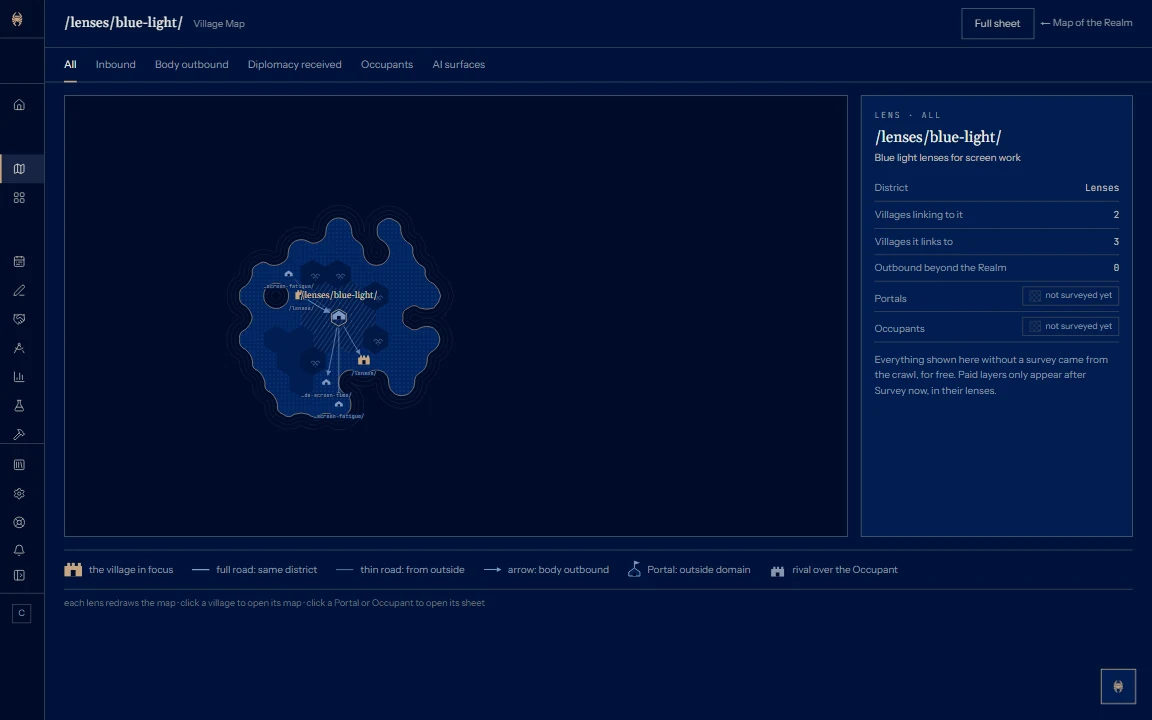
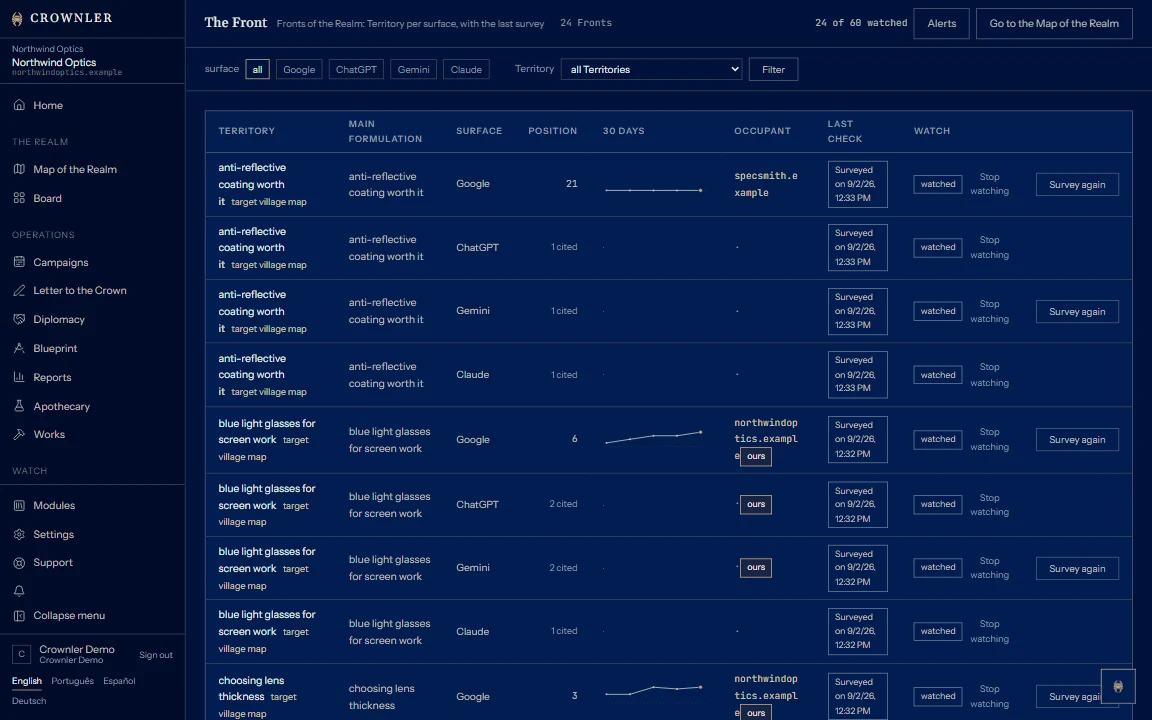
Screens from a demonstration project. The brand, the domain and the numbers are invented: no client data is shown.
02Who builds it
Three people answer for this
Digo Garcia
AI, technical SEO and engineering
Before this
Two decades of the Brazilian internet: Letras.mus.br, Cifra Club and Méliuz.
In the product
AI, technical SEO and engineering. The crawl that reads a whole site, the map that draws it, and the layer that talks to the models.
André Mousinho
SEO strategy
Before this
Took Rock Content's SEO past 7 million visits a month, and ran SEO for four brands in the LWSA group.
In the product
The method. How an intention becomes a territory, which finding is worth a client's attention, and what a report has to carry to survive the meeting.
Gabriel Raposo
Authority and press
Before this
Runs one of the most respected authority and press operations in Brazil, with work for Agibank and BTG.
In the product
The authority side. Backlinks, press, and the part of a plan that depends on other people's sites naming yours.
03The group
Crownler is a Netlinks Group tool
Netlinks Group is a holding of companies and products devoted to a single territory: search. Being found on Google, being cited by AI, and holding that ground with software, engineering and press.
Crownler is the software side of it. It is built by the group and used by the group, on the same client work that pays for it, which is the reason the product changes every week instead of every release cycle.
Backed by Google for Startups
Where the group is
01Brazil
Av. do Contorno, 5800
Savassi, Belo Horizonte, MG02England
125 Kingsway
London WC2B 6NH03Chile
Av. El Bosque Norte, 211
Las Condes, Santiago04Panama
Calle 50, PH Plaza 2000
Ciudad de Panamá
04The commitment
What a subscription carries beyond the software
What we learn reaches the people who pay for the tool first. What changed in AI answers, what started working, what stopped working, and why we think so.
The tool changes every week because we use it every day on real client work. What we find out, we pass on. That is the whole commitment, and it is the only part of it we can promise today.
Today that reaches you two ways: the blog, and the note that goes out by e-mail to clients. There is no closed group, no monthly call and no course, and we do not announce what does not exist.

05Talk to us