Generative engine optimization
Generative engine optimization, explained by what can be measured
The term is young and it already means five different things depending on who is selling it. This page says what it means here, and what a tool can honestly check about it.
Short version: GEO is the work of being read, named and correctly described in the answer a generative engine writes.
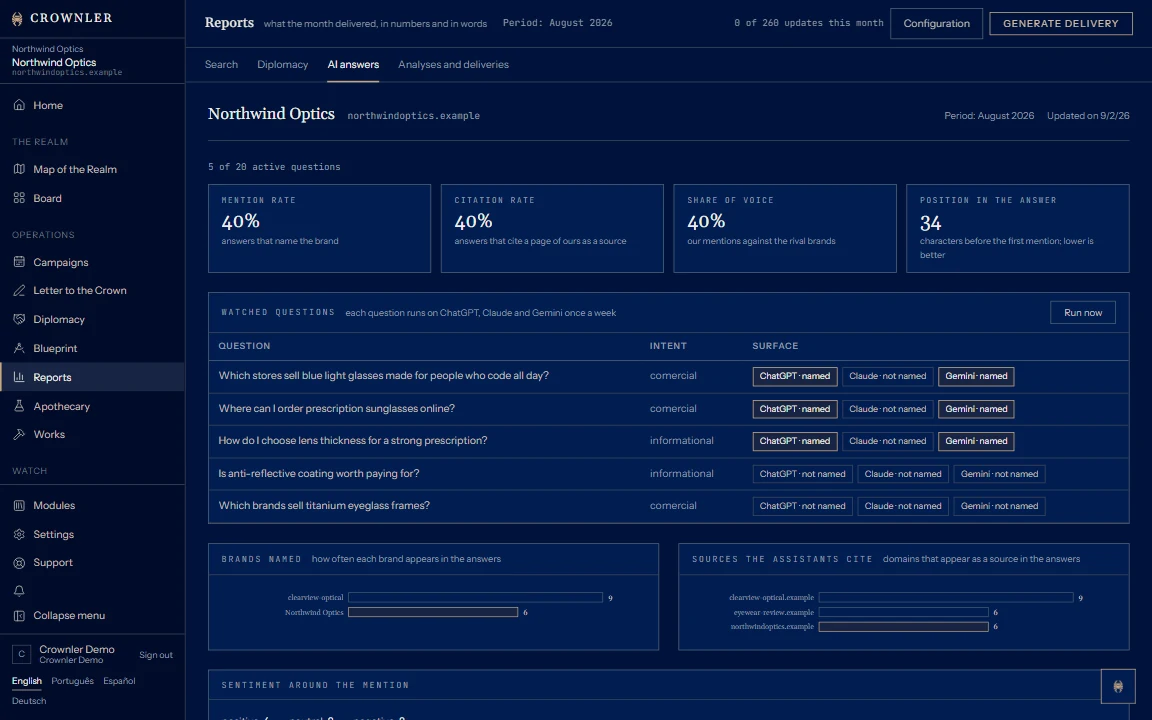
What generative engine optimization is
A generative engine answers in prose. It reads a handful of pages, some fetched live and some remembered from training, and writes a paragraph that names a few brands and cites a few sources. GEO is the work of being one of the pages it reads and one of the brands it names.
Most of that work is familiar. A page a crawler can reach, a claim stated plainly near the top, a fact that can be quoted without being rewritten, a company an engine can match to a real entity. What is new is the measurement, because there is no position to report and the answer is written again on every ask.
Two things get sold as GEO and cannot be delivered by anyone: a submission form to a model, and a guaranteed mention. Neither exists. If a page cannot be reached, understood and quoted, no vocabulary repairs it, and if it can, the engine still decides on its own.
The vocabulary this tool uses for the same idea is on the method page: a territory is the intention, and every surface where that intention gets asked is a front. GEO, in that language, is winning a front that happens to be written rather than listed.
What a tool can check about GEO today
Everything below is either measured by us or read from a paid provider on your click. Where the answer depends on something no tool can see, the line says so.
- Measured today
Whether the engine names you
The question goes to ChatGPT, Claude and Gemini through their APIs and the whole answer is stored, with the brands it named and the order it named them in.
- Measured today
Which sources the answer used
Every URL cited in the answer, grouped by domain. It is the closest thing a written answer has to a ranking: the pages the engine leaned on to say what it said.
- Measured today
Whether an AI Overview exists for the query
Read from the search result, with the domains and URLs the block cites, on the same trip that reads your organic position.
- Measured today
Whether your page can be read and quoted
The audit checks 42 rules on every crawled page: status, canonical, title and headings, thin content, broken internal links, images without alt. A page an engine cannot parse is a page it cannot quote.
- Measured today
How your pages link each other
The crawl builds the internal link graph, so a page nobody links, or one that only the menu reaches, shows up as exactly that.
- Not yet
Why the model chose someone else
No tool reads that, ours included. What is shown is who was chosen and which sources came with them, and that is the evidence the next month of work is built on.
This is the screen
The product running on a demonstration site, captured as it is, not redrawn for the page.
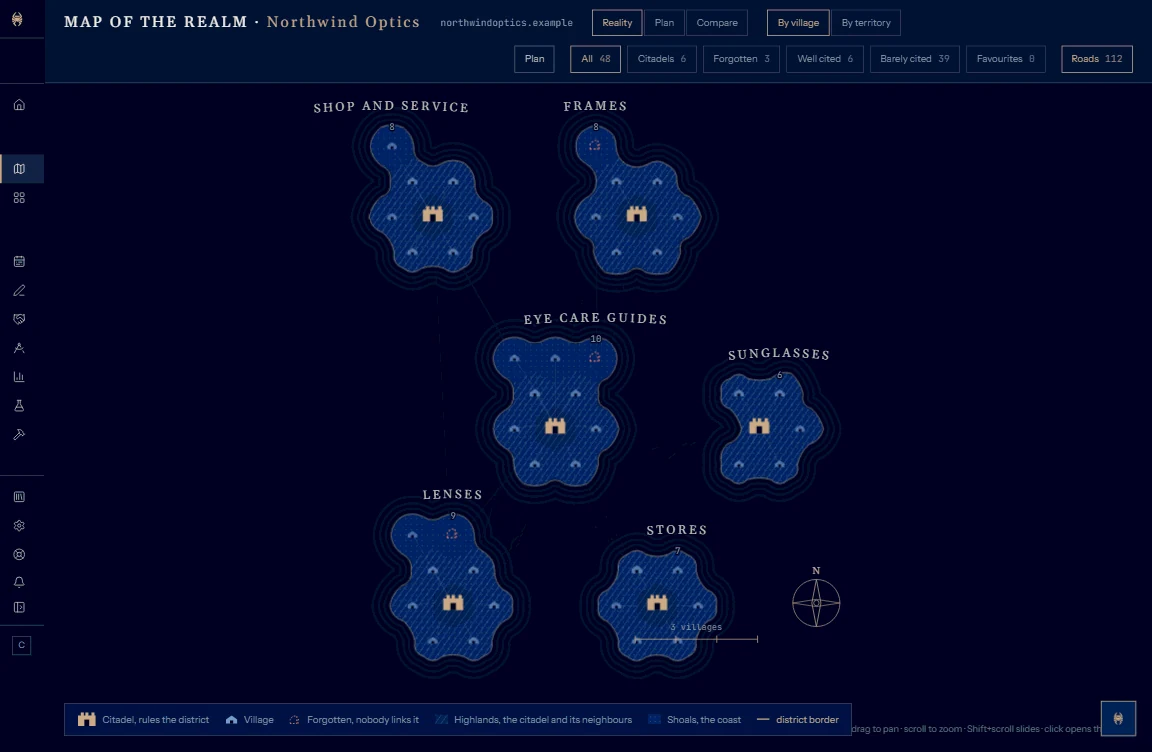
Screens from a demonstration project. The brand, the domain and the numbers are invented: no client data is shown.
How a territory gets worked
01
Write the question the way a buyer asks it
A whole question, carrying the constraint the buyer carries: the city, the budget, the industry, the deadline. It is longer than a keyword, and the length is the point.
02
Read the answer and the sources it cited
The source list is the map of who is feeding the engine. Part of it is reachable: a directory, a comparison article, a page of your own that is almost good enough.
03
Fix the page, then measure again
The blueprint module turns a page into a low fidelity wireframe with the rules checked as you edit, and the audit says whether the fix landed. Then the question runs again, next to the previous answer.
Who this is for
- SEO teams being asked by a board what GEO means and what it costs.
- Agencies who need a defensible answer, with evidence attached, before putting GEO on a proposal.
- Anyone who has already been sold a GEO package and wants to check what was delivered.
Who builds this
The company behind Crownler is backed by Google for Startups.
The tool is built by three people who do SEO for a living, and who use it on client work before it ships.
Digo Garcia
AI, technical SEO and engineering
Two decades of the Brazilian internet, with work at Letras.mus.br, Cifra Club and Meliuz. Doing SEO since 2003.
Andre Mousinho
SEO and GEO strategy
Led SEO strategy at Rock Content to more than 7 million visits a month, and led SEO for four brands in the LWSA group.
Gabriel Raposo
Link building and digital PR
Built one of the most respected authority and press operations in Brazil, with projects for Agibank and BTG.
Questions about GEO
How is GEO different from SEO?
Most of the work overlaps: a page that can be reached, understood and quoted serves both. What differs is the measurement and the shape of the result, a paragraph instead of a list. The method page shows how the same intention is followed on both.
Is GEO the same thing as AEO?
In practice people use the two terms for the same work. Generative engine optimization tends to name the engine that writes; answer engine optimization tends to name the answer itself. There is a page here for each term because people search for each term.
Can you guarantee a mention in ChatGPT?
No, and neither can anyone else. The model writes the answer again on every ask. What a tool can do is record whether you were named, who was named instead, and which sources the answer used.
Does adding schema markup make an engine cite me?
Structured data helps a machine understand a page, and the audit checks it. It works as a description, not as a lever, and a tool that promises otherwise is describing something it cannot observe.
How long until something changes?
We publish no number for that, because we have not measured one that would survive being quoted. What we do publish is the date of every measurement, so you read your own curve instead of an average of somebody else's.
Which engines are measured today?
ChatGPT, Claude and Gemini through their APIs, plus the AI Overview read from the Google result. Perplexity is in the data model and is not being queried yet.
Related pages
Same tool, a different question each time.
- SEO toolWhat the whole toolkit does, what it costs, and what it replaces.
- AI visibilityWhether the models name your brand, and who they name instead.
- AI SEO toolGoogle and AI answers measured on the same ground.
- Answer engine optimizationBeing the source an answer is built from.
- AI Overview trackingThe block above your result, query by query.
Plans from $79 to $379 a month. What changes between them is how many sites you run at once and how many of the 16 modules come in the licence.
Ask the question about your own brand
Open the workspace, enter the question your buyers ask and the site you would defend, and see who the answer is built from.