AI SEO tool
One tool for Google and for the answer engines
Two dashboards, two vocabularies, two invoices, and neither of them can tell you that you held the ranking and lost the answer.
Crownler reads your site as a map, treats an intention as one territory, and follows that territory across Google, the AI Overview and the models that write answers.
What changes when the answer is written instead of listed
Classic SEO software is built around a list: ten links, a position, a click. When the engine writes the answer, the list stops being the unit. A paragraph names two or three brands, cites a handful of pages, and everyone else is absent rather than tenth.
Software that only counts positions cannot see that. Software that only counts AI mentions cannot see the traffic still arriving from the ten links. The work is joining the two, because it is the same page and the same intention on both sides.
So Crownler keeps a single object: the territory, which is the intention itself and not the string someone typed. Every surface where that intention gets asked is a front, and each front carries its own position, its own occupant and the date it was measured.
What the tool actually does
There are 16 modules in the catalogue. These are the ones that answer the AI question; the product page carries the rest.
- Measured today
Your site read as a map
Our own crawler reads the sitemap and the pages and builds the internal link graph: which page links which, which cluster each one belongs to, and which pages nobody links at all.
- Measured today
Positions on Google and AI Overview
Read from the search result itself, with the real URL of each occupant, so the block above your result is measured on the same trip as the ten links below it.
- Measured today
Answers from ChatGPT, Claude and Gemini
Your question sent to each model through its API, the answer stored whole, and the mentions and cited sources read out of it.
- Measured today
An audit with {regras} rules
Every crawled page checked against 42 rules, each finding carrying the evidence that produced it. Plans carry a monthly page count for it.
- Measured today
Reports the client can open
Search Console, analytics, positions, backlinks and AI answers in one dashboard, with a public link to send and your agency brand on it when white label is on.
- Measured today
External data bought on the click
Provider data for search results, backlinks and keywords is fetched when you open or click, never crawled in bulk, and the allowance is debited before the call goes out.
- Not yet
Perplexity as a surface
It is in the data model and it is not being queried: the key is not configured yet. It appears on this list so nobody buys expecting it.
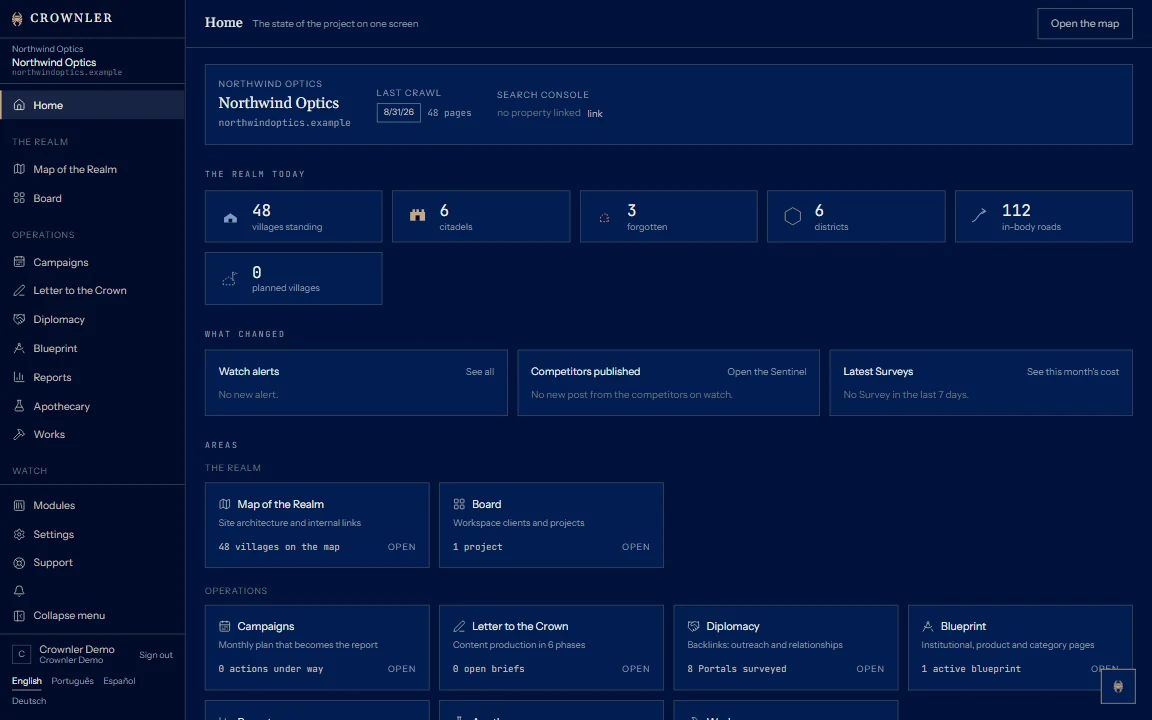
This is the screen
The product running on a demonstration site, captured as it is, not redrawn for the page.
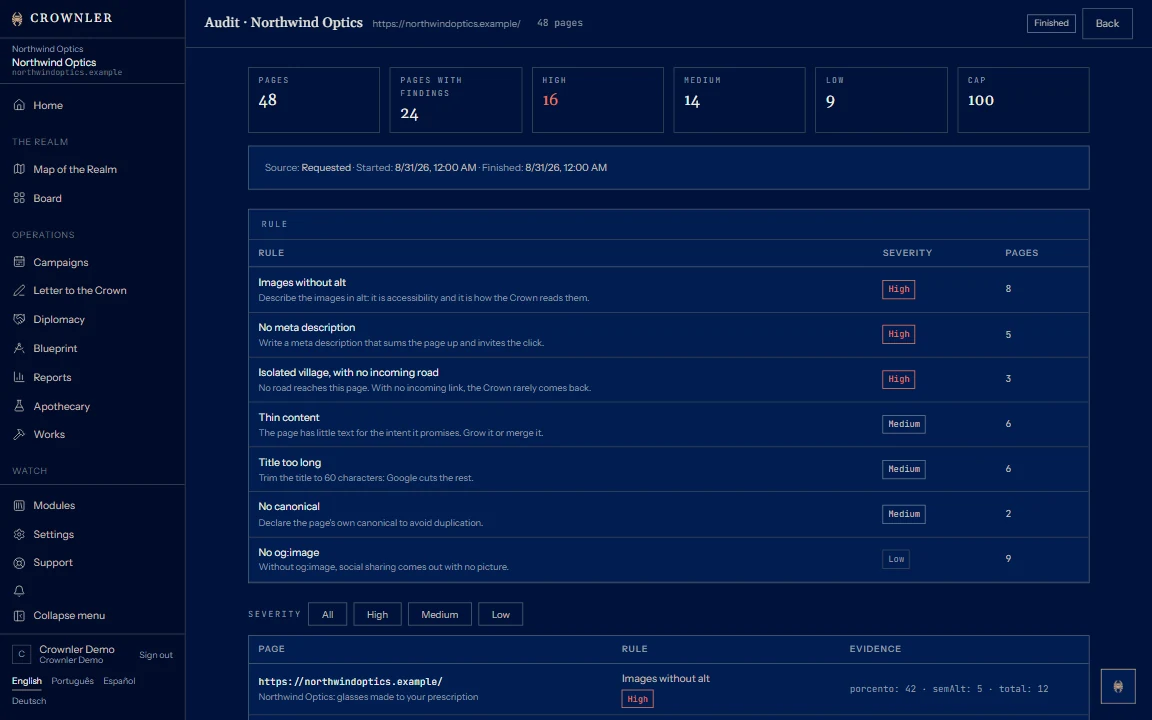
Screens from a demonstration project. The brand, the domain and the numbers are invented: no client data is shown.
How a first week goes
01
Point it at the site
You give the address. The crawler reads the sitemap and the pages, draws the map, and shows the clusters, the page that leads each one and the pages nobody links.
02
Name the intentions
A territory is an intention. You register the ones that matter, and the keyword typed into Google and the question asked of a model sit under the same object as two formulations of it.
03
Watch the fronts
Each front carries its surface, its position, who occupies it and when it was measured. When the answer changes, the previous one is still there to compare against.
Who this is for
- Agencies that already sell SEO and are being asked, this quarter, what they are doing about AI.
- In-house teams paying two subscriptions to answer one question about the same page.
- Consultants who bill by client and need the cost to follow the number of sites.
Who builds this
The company behind Crownler is backed by Google for Startups.
The tool is built by three people who do SEO for a living, and who use it on client work before it ships.
Digo Garcia
AI, technical SEO and engineering
Two decades of the Brazilian internet, with work at Letras.mus.br, Cifra Club and Meliuz. Doing SEO since 2003.
Andre Mousinho
SEO and GEO strategy
Led SEO strategy at Rock Content to more than 7 million visits a month, and led SEO for four brands in the LWSA group.
Gabriel Raposo
Link building and digital PR
Built one of the most respected authority and press operations in Brazil, with projects for Agibank and BTG.
Questions about the tool
Is this an SEO tool or an AI tool?
It is one tool. The crawl, the map, the audit and the reports are classic SEO work. The answers from the models and the AI Overview are the new surface. Both hang on the same territory, which is why they can be compared.
Do I need to install anything on my site?
No. The crawler reads your site from the outside like any other robot, and Search Console and analytics are connected by authorising the account. There is no tag, no plugin and no code change.
What is unlimited and what draws on the allowance?
The crawl and the map are ours and cost nothing external. The audit is ours as well and still carries a monthly page count per plan. Provider data and anything an AI writes are counted, and the count is debited before the call.
Which languages does it speak?
4: English, Portuguese, Spanish and German, and the addresses change with the language too, so a German reader gets German URLs and not a translated shell over English paths.
Can I use it for several clients?
Yes. Plans are sized by number of projects, and each project is one site with its own map, its own territories and its own reports. Access can be granted per project.
Is there an API?
Yes, a versioned HTTP API with keys issued per workspace and a daily call ceiling per key. It covers projects, pages, audits and content, and it is documented in the app.
Related pages
Same tool, a different question each time.
- SEO toolWhat the whole toolkit does, what it costs, and what it replaces.
- AI visibilityWhether the models name your brand, and who they name instead.
- Generative engine optimizationWhat GEO is, and what a tool can measure about it.
- Answer engine optimizationBeing the source an answer is built from.
- AI Overview trackingThe block above your result, query by query.
Plans from $79 to $379 a month. What changes between them is how many sites you run at once and how many of the 16 modules come in the licence.
Bring one site and see it drawn
Open the workspace, enter the site, and the crawl draws the map of its pages and internal links right there.