AI Overview tracking
Track the AI Overview that sits above your result
Google now answers a share of queries in a block above the ten links, crediting a handful of sites. Your position did not move. The space above it did.
Crownler reads that block on the same trip that reads your ranking, records which sites it credits, and puts your own Search Console numbers for the same query beside it.
What an AI Overview changes on a result page
An AI Overview is a written answer Google places above the organic results for some queries. It credits a small set of pages, it shows up for some queries and not others, and it comes and goes for the same query over time. That last part is why a single check is worth little and a series is worth something.
The block pushes your ranking down the page. Two things follow. Presence in the block became a position worth tracking, and your own click data became the only honest read of what the block did to you.
This is where the market gets loose. There are widely quoted figures for how much traffic an AI Overview costs. We publish none of them, because we have not measured one that would survive being quoted. What we publish is your query, your clicks, your impressions and the date of every reading.
What is recorded on every reading
One reading is one call to a paid provider, made when you click. Nothing here is crawled in bulk overnight, which is what makes bulk tracking expensive.
- Measured today
Whether the block appeared
The Google result is read with all of its blocks, so the AI Overview is recorded when it is there, and its absence is recorded when it is not.
- Measured today
Which sites the block credits
The domains and URLs cited inside the block, each with its real address and the position it holds on the page, so you can see who is supplying the answer above you.
- Measured today
The real destination, already resolved
Google now writes result links as a redirect instead of the destination. The provider we buy from returns the resolved address, so the URL you read is the real one, and no request touches the target site.
- Measured today
Your organic position, same timestamp
The ten links come back in the same call, so the block above and your position underneath carry the same date and can be read as one picture.
- Measured today
Your own clicks and impressions
Pulled per query and per page from your own Search Console property, so the comparison is made against your data rather than an industry average.
- Not yet
How much traffic the block cost you
Google does not separate it. Search Console counts a click from the result page without saying which block sent it. A tool that shows a percentage there is estimating, and it should say so.
This is the screen
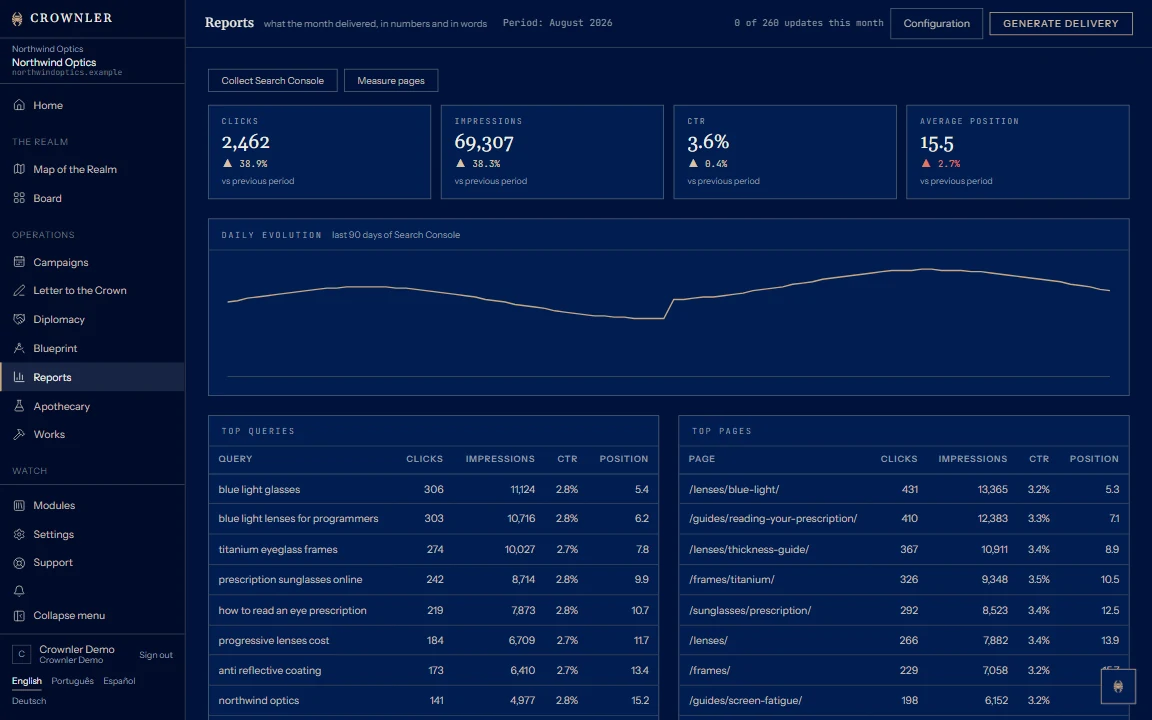
The product running on a demonstration site, captured as it is, not redrawn for the page.
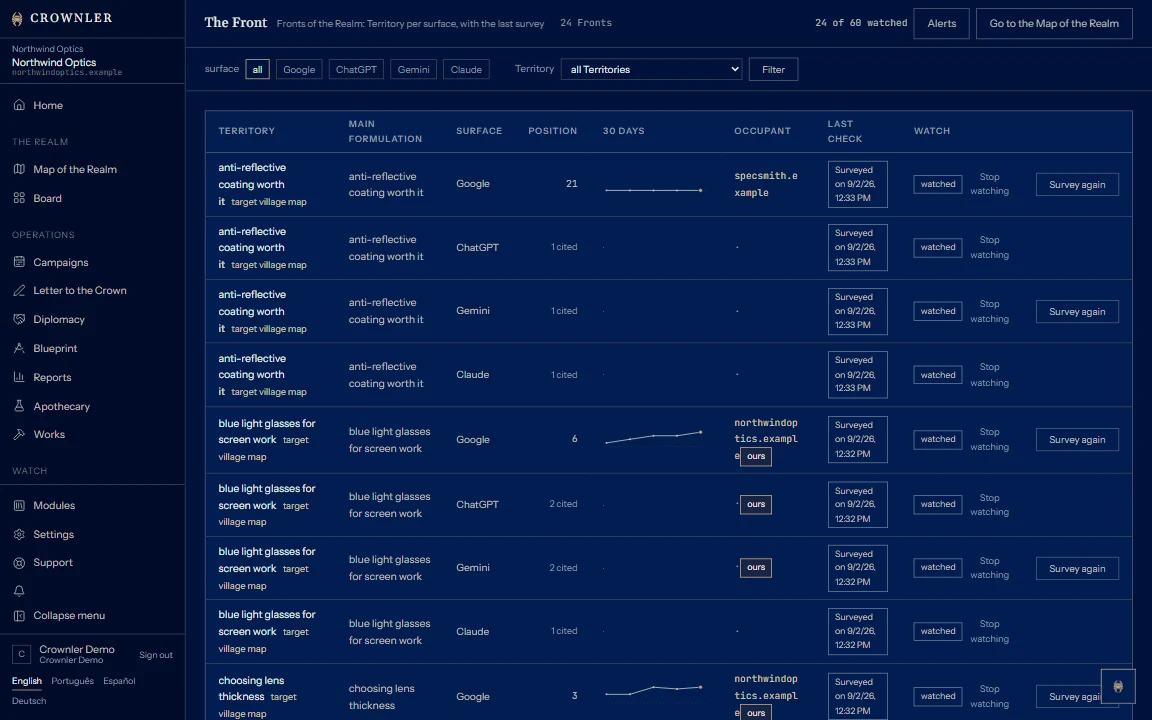
Screens from a demonstration project. The brand, the domain and the numbers are invented: no client data is shown.
How to track it
01
Pick the queries that matter
A front is a territory measured on one surface. Add the AI Overview surface to the territories you already watch, and the block joins the same history as your ranking.
02
Read it on your click
The result is bought from a provider when you open or click, and the monthly allowance is debited before the call. A repeat click inside the cache window costs nothing at all.
03
Watch the series
The block appears and disappears. One reading tells you about one moment, and the history is where the pattern lives, so every reading keeps its own date and its own evidence.
Who this is for
- Teams whose traffic fell without a ranking falling with it.
- Agencies that have to explain a growing gap between impressions and clicks in a monthly report.
- Anyone who was quoted an AI Overview statistic and asked to check it against their own site.
Who builds this
The company behind Crownler is backed by Google for Startups.
The tool is built by three people who do SEO for a living, and who use it on client work before it ships.
Digo Garcia
AI, technical SEO and engineering
Two decades of the Brazilian internet, with work at Letras.mus.br, Cifra Club and Meliuz. Doing SEO since 2003.
Andre Mousinho
SEO and GEO strategy
Led SEO strategy at Rock Content to more than 7 million visits a month, and led SEO for four brands in the LWSA group.
Gabriel Raposo
Link building and digital PR
Built one of the most respected authority and press operations in Brazil, with projects for Agibank and BTG.
Questions about AI Overview tracking
How do you read the AI Overview?
From the search result itself, through a paid provider, on your click. There is no browser automation on our side and no scraping of Google by us, which is also why a result page redesign does not take the feature down.
Google hides the destination URL now. Does that break tracking?
It changed how the result page is written: the link points at a Google redirect instead of the destination. The provider resolves it, so the address you read is the real one, and resolving it never touches the target site.
How often is the block checked?
On your click, and on the schedule you set for a watched front. Crawling every query every day is what makes bulk tools expensive, and it is not how this one works.
Can you tell me how many clicks I lost to it?
No, and an estimate will not be printed here as if it were a measurement. Search Console counts the click from the result page without naming the block. What you get is presence, position and your own numbers, each with its date.
Does this work outside Brazil?
Yes. Each project carries a country, and the country decides the location and language of the search. Brazil, the United States, Spain, Germany, Portugal and Mexico are mapped today, and the interface speaks 4 languages.
What does one reading cost?
It draws on the monthly allowance of your plan for external data, and the debit happens before the call goes out, so the ceiling holds even on a busy afternoon. The figures are on the plans page.
Related pages
Same tool, a different question each time.
- SEO toolWhat the whole toolkit does, what it costs, and what it replaces.
- AI visibilityWhether the models name your brand, and who they name instead.
- AI SEO toolGoogle and AI answers measured on the same ground.
- Generative engine optimizationWhat GEO is, and what a tool can measure about it.
- Answer engine optimizationBeing the source an answer is built from.
Plans from $79 to $379 a month. What changes between them is how many sites you run at once and how many of the 16 modules come in the licence.
Check one query on your own site
Open the workspace, enter the query and the page that should be ranking for it, and watch the block above your result.